The skeleton to copy
Paste this into Discord, a doc, or your planning tool and fill it in from the top. Delete any line that does not apply to this op.
OPORD [number] - OPERATION [NAME]

1. SITUATION
Enemy: who, how many, where, what they are likely to do.
Friendly: who is on our side, who supports us.
Terrain and weather: what helps or hurts movement and sight.

2. MISSION
[Who] [does what] [where] [when] [why], in one sentence.

3. EXECUTION
Intent: what success looks like when it is over.
Phase 1: [movement, positions, timing]
Phase 2: [the main action, who does what]
Phase 3: [consolidate, report, exfil]
Tasks: one line per element (1PLT, 2PLT, WPNS, ...).
Rules of engagement: when to fire, what not to hit.

4. SUSTAINMENT
Medics and casualty collection point.
Resupply, vehicles, respawn or reinforcement rules.

5. COMMAND AND SIGNAL
Who leads, and who takes over if they go down.
Radio nets, code words, and how to report.
What goes in each paragraph
- Situation. What the unit faces before it moves. Say where the enemy is with a grid reference, how many there are, and what you expect them to do. Add which friendly units are around and anything about the terrain that changes the plan, such as an open field or a river with one bridge.
- Mission. One sentence with who, what, where, when, and why. "1PLT seizes OBJ BARN at H+30 to open the road for the convoy." If people remember one line, it is this one.
- Execution. The longest paragraph. Start with the commander's intent: the end state, in plain words, so people can act when the plan breaks. Then the phases in order, then one task line per element.
- Sustainment. How people stay in the fight: medics, the casualty collection point, ammo and vehicles. In a game, this is also where respawn or reinforcement rules go.
- Command and signal. Who is in charge, the order of succession, which radio net each element uses, and the code words. A code word for "objective taken" saves a lot of talking.
Make it work for a game night
- Short beats complete. Most players read the order once, often on a phone. One screen per paragraph is a good limit.
- Use op time, not clock time. H-hour is when the op starts; H+30 is 30 minutes in. Server starts slip, op time does not.
- Name places once, then use the name. Give objectives short code names (OBJ BARN) and grid references, so "the farm over there" never comes up on the radio.
- Draw what you write. Every objective, phase line, and unit in the text should be on the map, with the same name.
- Say what happens when it goes wrong. The intent and the succession line are what keep a squad moving after the leader goes down.
A short example
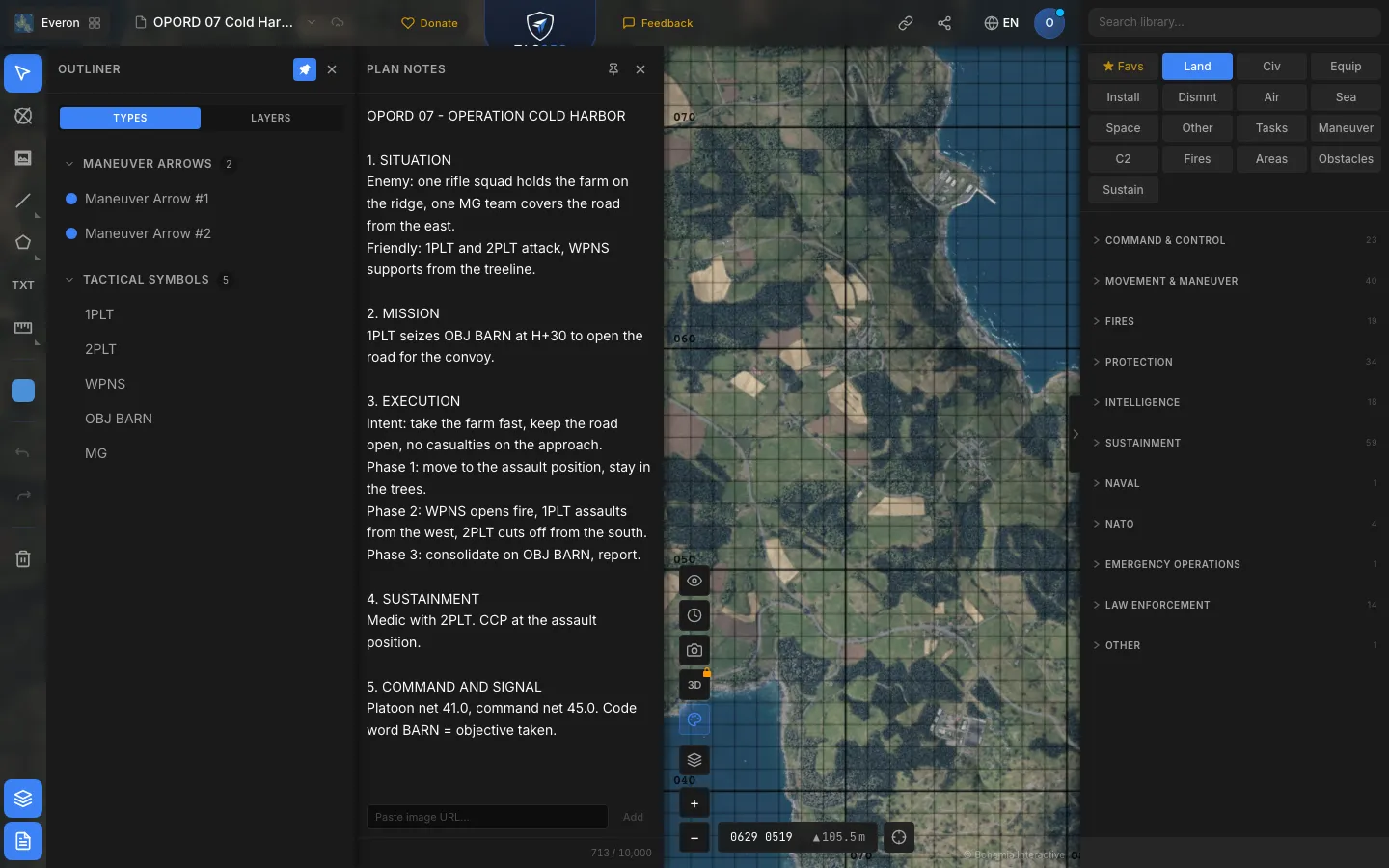
OPORD 07 - OPERATION COLD HARBOR

1. SITUATION
Enemy: one rifle squad holds the farm on the ridge, one MG team
covers the road from the east.
Friendly: 1PLT and 2PLT attack, WPNS supports from the treeline.

2. MISSION
1PLT seizes OBJ BARN at H+30 to open the road for the convoy.

3. EXECUTION
Intent: take the farm fast, keep the road open, no casualties on
the approach.
Phase 1: move to the assault position, stay in the trees.
Phase 2: WPNS opens fire, 1PLT assaults from the west, 2PLT cuts
off from the south.
Phase 3: consolidate on OBJ BARN, report.

4. SUSTAINMENT
Medic with 2PLT. CCP at the assault position.

5. COMMAND AND SIGNAL
Platoon net 41.0, command net 45.0. Code word BARN = objective taken.
How TacOps does this step
In TacOps the order lives next to the map. Each plan has a Plan Notes panel for the text, up to 10,000 characters, and you place the units, objectives, and arrows from the order on the same map. When you share the plan, people read the notes and the map from one link, on a desktop or a phone, and they need no account to view it.
More guides: how to write an op order, NATO map symbols explained, and how to brief on a phone.